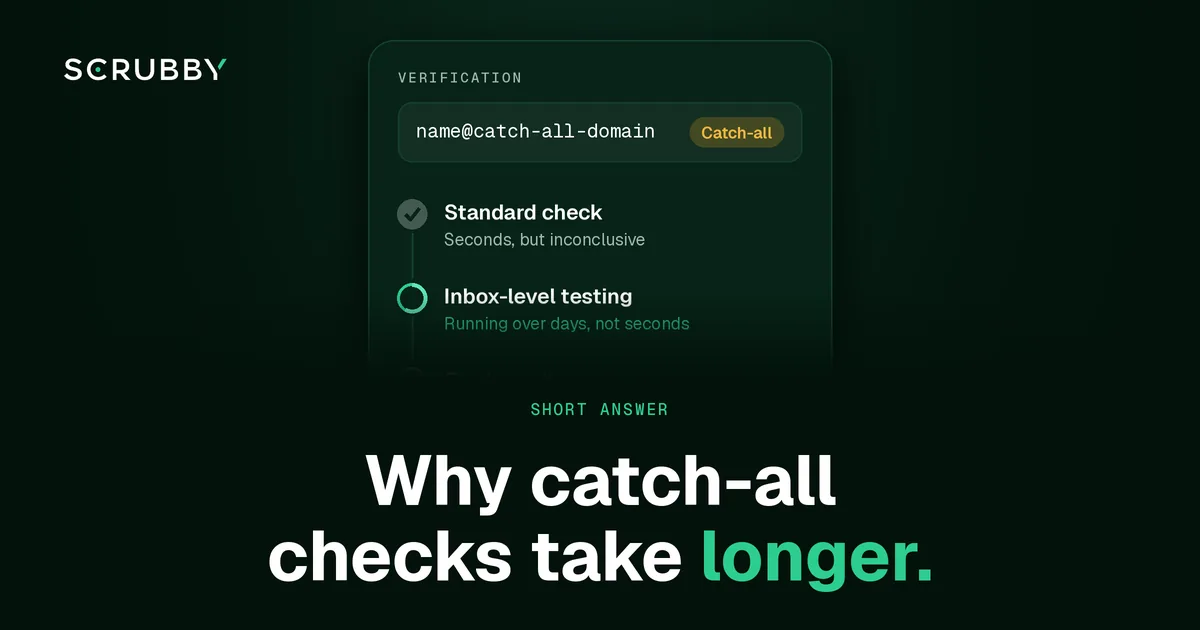
Short answer: a standard verifier checks a catch-all address in seconds, but it cannot tell you whether the mailbox is real, so it returns “Catch-All”, “Risky” or “Accept-All”. Quick Verification goes further: it checks a full list in minutes and includes a catch-all probe that settles most of these addresses, at 1 credit per email. For the addresses that probe cannot settle, Deep Verification sends real email and watches how mail servers respond over 72 hours. First results arrive in 24 hours, and the final verdict in 72 hours, at 3 credits per email.
Why a Normal Check Is Fast but Inconclusive
A standard verifier talks to the recipient’s mail server and asks whether a mailbox exists, without sending an email. On most domains that takes seconds and gives a clear yes or no.
A catch-all domain answers yes for every address, real or not. The check still finishes in seconds, but the answer carries no information. That is why your verifier puts these addresses in a separate bucket instead of calling them valid. Our guide to what a catch-all email account is explains the setup on the server side.
Why Resolving Catch-All Takes Longer
To find out whether a catch-all address is real, you have to look past the server’s automatic yes. Where a catch-all probe still cannot settle the address, Scrubby’s Deep Verification sends real email and watches how the mail server responds over 72 hours, rather than relying on the instant SMTP response. Some signals only show up after a delay: most addresses resolve in the first 24 hours, and delayed bounces can surface through 72 hours, so the check needs that window rather than a single moment.
Turnaround at a Glance
| Check | Typical turnaround | Resolves catch-all? | Scrubby cost |
|---|---|---|---|
| Standard SMTP verification | Seconds per address | No | Not a Scrubby check |
| Quick Verification | Minutes for a full list | Most addresses, via a catch-all probe | 1 credit per email |
| Deep Verification | First results in 24 hours, final in 72 hours | The remainder: real email sent, behaviour observed | 3 credits per email |
Times depend on list size and the domains involved.
How to Plan Around the Wait
- Split the list. Run everything through Quick Verification first. Only the addresses it cannot settle need Deep Verification.
- Start early. Upload that remainder at least three days before the campaign that needs it. Final Deep Verification results are in at 72 hours.
- Send the valid segment now. You do not have to hold the whole campaign for the catch-all results.
- Add resolved contacts later. Once results come back, add the valid catch-all addresses to the sequence and suppress the invalid ones.
Our guide to verifying catch-all emails at scale covers the full workflow.
FAQ
Can catch-all verification be done in real time? Not reliably. A real-time check can only see the server’s instant response, which is always yes on a catch-all domain.
Do I need to resolve every catch-all address? Not always. If a segment is small or low value, you can drop it. On B2B lists, where catch-all domains are common, resolving them usually recovers contacts you would otherwise lose.
Is it safe to send to catch-all addresses without checking? It carries risk. Unverified catch-all addresses can bounce after delivery or hit inactive mailboxes, which hurts your sender reputation.
How do I try it? Scrubby includes 200 free credits, enough to test a sample of your catch-all segment. See pricing.

Amit S.
Marketing Lead