Reoon Email Verifier has earned a solid following, and it is easy to see why. It is quick, it is inexpensive, and it clears a big list without much fuss. For teams who mostly send to standard mailboxes, that combination covers a lot of ground.
The problem shows up at the edge of the list, on the addresses Reoon cannot resolve cleanly. Catch-all domains, greylisted servers, and risky mailboxes all land in a bucket that is neither valid nor invalid. When those results pile up, you are left with a familiar bad choice: send to them and risk bounces, or delete them and throw away real buyers. If you keep hitting that wall, it is worth looking at a Reoon Email Verifier alternative that is built to resolve exactly those addresses instead of labeling them and moving on.
What Reoon Email Verifier does well
Credit where it is due. Reoon covers the fundamentals most bulk verifiers are expected to handle:
- Syntax and format checks that catch typos and malformed addresses.
- MX and domain checks that confirm a domain can actually receive mail.
- Disposable and temporary address detection so throwaway signups get flagged.
- Role-based flags for generic inboxes like info@ and sales@.
- Fast bulk processing at a price that suits smaller teams and one-off cleanups.
For a list made up mostly of normal, deliverable business or consumer inboxes, this is a reasonable toolkit. The engine is quick and the per-verification cost is low, which is a big part of why people reach for it.
Where Reoon falls short: the catch-all problem
Here is the gap. A large share of business email today sits behind catch-all domains, servers configured to accept mail for any address at the domain, whether or not the specific mailbox exists. When a verifier runs a standard SMTP check against a catch-all domain, the server says yes to everything. It cannot tell you whether [email protected] is a real person or a typo that will hard bounce next week.
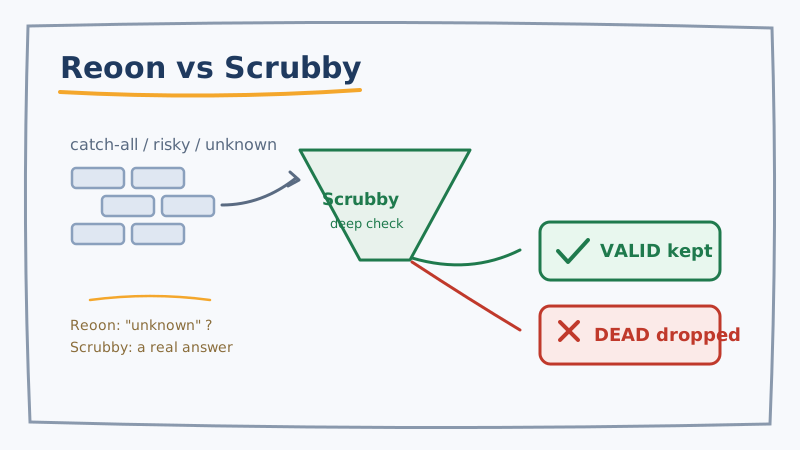
Most verifiers, Reoon included, respond by tagging these addresses as “catch-all,” “accept-all,” “unknown,” or “risky” and handing the judgment call back to you. That label is honest, but it is not an answer. On a real B2B list, catch-all and unknown results routinely account for 20 to 40 percent of contacts, and many of them are decision-makers at exactly the companies you want to reach.
That leaves you stuck with two lossy options:
- Delete the unknowns. Safe for your bounce rate, but you just discarded a large slice of your total addressable market, including good contacts.
- Send to the unknowns anyway. You keep the reach, but every dead address that bounces chips away at your sender reputation and pushes more of your mail into spam folders.
Neither option is a real fix. It is just a way of paying for the tool’s blind spot with either lost revenue or lost deliverability.
What to look for in a Reoon alternative
If catch-all and risky addresses are the reason you are shopping, judge any alternative on how it handles that specific category, not on how fast it clears the easy stuff. The bar that matters:
- Real verdicts on catch-all addresses, not just a “risky” or “unknown” label.
- Verification of risky and greylisted mailboxes that most SMTP checks give up on.
- Low false-invalid rate, so good contacts are not deleted by mistake.
- Bounce-rate protection that keeps you safely under the thresholds Gmail, Outlook, and Yahoo enforce.
- Simple integration with the tools you already send from, so cleaning a list does not become a project.
How Scrubby handles the addresses Reoon skips
Scrubby was built specifically for the hard bucket, the catch-all and risky addresses that generic verifiers cannot resolve. Instead of running one SMTP probe and giving up when the server accepts everything, Scrubby uses a deeper, multi-signal verification process to determine whether a specific mailbox behind a catch-all domain actually exists.
The practical result is a real valid-or-invalid verdict on addresses Reoon would have handed back as “unknown.” That difference is the whole point. When Scrubby confirms a catch-all address as deliverable, you can send with confidence. When it confirms one as dead, you remove it before it ever hits a mail server. Either way, you stop guessing.
That is how you recover the 20 to 40 percent of a B2B list that other tools quietly write off. You keep the good contacts hiding inside the catch-all bucket, and you drop the dead ones that would otherwise bounce and drag down your reputation. For cold outreach teams, that recovered slice often includes the exact prospects that make a campaign profitable. Pairing a clean, fully verified list with a calendar-first outreach tool like Kali means those recovered contacts turn into booked meetings instead of bounces.
Reoon vs Scrubby at a glance
| Capability | Reoon Email Verifier | Scrubby |
|---|---|---|
| Syntax and MX checks | Yes | Yes |
| Disposable and role-based detection | Yes | Yes |
| Fast bulk processing | Yes | Yes |
| Catch-all and accept-all verification | Flags as unknown or risky | Resolves to valid or invalid |
| Risky and greylisted mailboxes | Often unresolved | Verified |
| Recovers contacts other tools discard | Limited | Core strength |
| Best fit | Cheap, standard-list cleanups | High-value B2B and catch-all-heavy lists |
When Reoon is fine, and when to switch
Reoon is not a bad tool. If your lists are mostly standard consumer or small-business inboxes, your catch-all percentage is low, and price is your top priority, it will do the job.
You should look hard at an alternative when:
- A large chunk of your list comes back as catch-all, accept-all, or unknown.
- You sell B2B, where catch-all domains are the norm rather than the exception.
- You are deleting risky contacts just to be safe and suspect you are throwing away real buyers.
- Your bounce rate is creeping up even after you run a standard verifier.
- Every lead is expensive, so recovering the unknown bucket has real dollar value.
In those situations, the cheapest verification is not the one with the lowest per-check price. It is the one that saves the most real contacts and keeps you out of the spam folder.
Making the switch is straightforward
Moving off Reoon does not require ripping out your workflow. Export the list you want to clean, or just the addresses Reoon flagged as catch-all, risky, or unknown, and run them through Scrubby. You will get clean valid-or-invalid verdicts on the exact segment that used to be a shrug. From there, upload the verified list back into your sending platform, CRM, or cold outreach tool and send.
A good habit is to keep verification continuous rather than one-and-done. Lists decay, people change jobs, and mailboxes get deprovisioned, so re-verifying before each major send keeps your reputation steady and your bounce rate low over time.
The bottom line
Reoon Email Verifier is a capable, low-cost bulk checker for standard lists. Where it runs out of road is the catch-all and risky bucket, the addresses it labels but cannot resolve, and on many B2B lists that bucket is where a big share of your revenue is hiding.
If you are tired of choosing between deleting good leads and risking your deliverability, Scrubby is the Reoon alternative built for exactly that gap. It verifies the catch-all and risky addresses other tools skip, so you keep more real contacts, bounce less, and protect the sender reputation your whole email program depends on.

Amit S.
Marketing Lead