Bounce rate is one of the few email metrics that mailbox providers watch as closely as you do. Open rate is yours to obsess over. Bounce rate belongs to Gmail, Outlook, and Yahoo, and they use it to decide whether your next thousand messages land in the inbox, the spam folder, or nowhere at all.
The problem is that most teams discover their bounce rate is too high only after the damage is done. A campaign goes out, deliverability craters, and the post-mortem reveals a number that crept past the line weeks ago. By then you are not just fixing a list, you are repairing a reputation.
This post lays out what a healthy bounce rate actually looks like by industry, the threshold where providers start throttling you, and the cheapest way to stay on the right side of it.
What counts as a bounce, and why providers care
A bounce is a message a receiving server refused to deliver. There are two kinds, and the difference matters.
A hard bounce is a permanent failure: the address does not exist, the domain has no mail server, or the mailbox has been shut down. Hard bounces are the ones that wreck reputation, because a sender who keeps hitting dead addresses looks either careless or like a spammer working off a scraped list.
A soft bounce is a temporary failure: the mailbox is full, the server is briefly down, or the message is too large. Soft bounces are noise. A few are normal. Persistent soft bounces to the same address eventually get treated like hard bounces.
Mailbox providers care because hard bounce rate is one of the clearest signals of list hygiene they have. A pristine list that someone built and validated behaves differently from a list someone bought. The bounce rate tells the provider which one you are sending.
Bounce rate benchmarks by industry
There is no single “good” bounce rate, because list-building norms differ by sector. These are reasonable working benchmarks for a healthy, permission-based list. Treat anything meaningfully above the high end as a signal to audit before your next send.
| Industry | Healthy bounce rate | Watch zone |
|---|---|---|
| SaaS and technology | Under 1.0% | 1.0% to 2.0% |
| Ecommerce and retail | Under 0.7% | 0.7% to 1.5% |
| Financial services | Under 1.2% | 1.2% to 2.5% |
| Healthcare | Under 1.5% | 1.5% to 3.0% |
| Education | Under 1.5% | 1.5% to 3.0% |
| Media and publishing | Under 0.5% | 0.5% to 1.2% |
| B2B lead generation | Under 2.0% | 2.0% to 4.0% |
Two patterns explain the spread. Industries that collect addresses through tightly controlled, double opt-in flows (media, ecommerce) sit lowest. Industries that ingest addresses from forms, events, partners, and purchased data (B2B lead gen, finance) run higher because the inputs are messier.
If your list-building looks like the messy end of that spectrum, you do not get a pass on the threshold below. You get a stronger reason to validate.
The threshold that gets you throttled
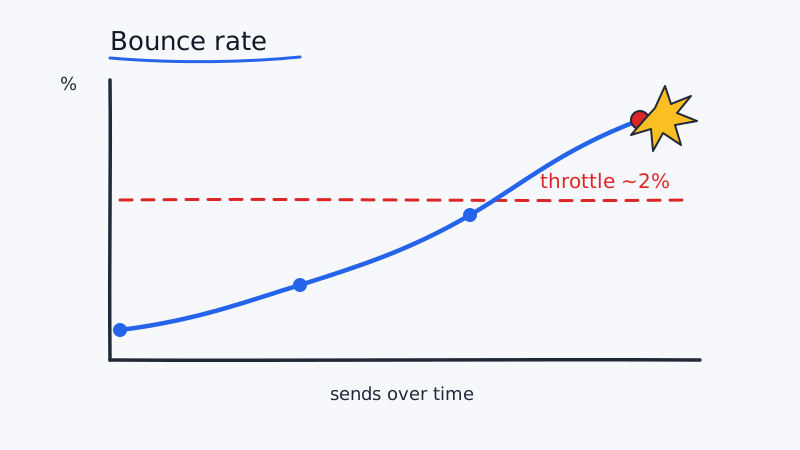
Here is the number that actually matters: most major mailbox providers begin penalizing senders once hard bounce rate crosses roughly 2%, and the response sharpens fast above that.
The penalty is rarely a clean on or off switch. It escalates:
- Around 2%: providers start throttling. Your messages are accepted more slowly, and a growing share is routed to spam rather than the inbox.
- Around 5%: throttling becomes aggressive, and some providers begin outright rejecting connections from your sending IP or domain.
- Above 5% sustained: you risk blocklisting, where the damage outlives the single campaign and follows your domain into future sends.
The cruel part is that bounce damage compounds. A high-bounce send lowers your sender reputation, which lowers inbox placement on the next send, which lowers engagement, which lowers reputation again. You can dig out, but it takes weeks of careful low-volume sending to dead-clean lists, and you lose revenue the entire time.
The point of knowing the threshold is not to ride right up to it. It is to keep a wide margin, because you do not control the exact line and it moves.
Why “accept-all” domains break your bounce math
Even teams that scrub their lists get blindsided by one category: catch-all, or accept-all, domains. These are mail servers configured to accept every message at the connection stage, then decide later whether the mailbox actually exists.
Standard validation tools mark these addresses as “unknown” or “risky” because a normal SMTP check cannot confirm them. So they sit in your list as a quiet gamble. Send to them, and a chunk silently hard-bounces after the fact, dragging your rate up exactly when you thought your list was clean.
This is the gap that generic validators leave open, and it is why catch-all resolution matters so much for anyone whose list skews B2B. Resolving catch-alls is the entire reason Scrubby exists: it verifies the addresses other tools give up on, so the “unknown” pile stops becoming next month’s bounce spike. If you have ever wondered why a freshly validated list still bounced, accept-all domains are usually the answer.
How to stay under the line
You do not need a complicated program. You need a few habits applied consistently.
Validate before every major send, not just at import. Lists decay at roughly 2% to 3% per month as people change jobs and abandon inboxes. A list you validated in January is measurably worse by March. Re-validate before any high-stakes campaign.
Validate at the point of capture. Catching a typo or a fake address at the signup form is the cheapest validation you will ever do. It stops the bad address from ever entering the list.
Segment by risk and suppress the unknowns you cannot resolve. If an address cannot be verified, do not send to it during a reputation-sensitive campaign. Hold it back and treat it separately.
Warm up new sending domains. A brand new domain blasting volume looks exactly like a spammer. Ramp gradually so providers learn your pattern before you scale.
Watch the trend, not just the snapshot. A bounce rate climbing from 0.4% to 0.9% over three sends is a warning even though both numbers look fine. The slope tells you the list is aging or the source is degrading.
Teams that pair clean lists with the right outreach channel see the biggest gains. If cold email deliverability keeps fighting you despite a clean list, it is worth testing channels that sidestep the inbox-filtering problem entirely, like the cold calendar invite approach Kali is built around. A validated list plus a channel that lands is a stronger combination than either alone.
The bottom line
Bounce rate is a leading indicator of deliverability trouble, and the threshold that matters is lower than most teams assume. Stay comfortably under 2%, treat any climb as a signal rather than a snapshot, and never let unresolved accept-all addresses turn a clean list into a dirty one.
The cheapest deliverability program is the one that prevents the bounce in the first place. Validate before you send, resolve the addresses other tools skip, and you keep the only email metric that mailbox providers fully control firmly on your side.

Nick Abraham
Cold Email Expert